Air Compressor Basics
At its core, an air compressor converts mechanical energy from a power source into potential energy stored in compressed air. The air compression process typically involves four key stages:
1. Drawing in Ambient Air
The compressor pulls in air from the surrounding environment through an intake valve. An air filter is usually installed to remove dust, dirt, and other contaminants, ensuring clean air enters the system.
2. Compressing the Air
Once inside the compression chamber, the air is compressed by a piston, rotary screw, or other compression mechanism. As the air volume decreases, its pressure increases, creating a supply of high-pressure air.
3. Storing Compressed Air
The compressed air is then stored in an air receiver tank for later use. This storage tank helps maintain a steady supply of pressurized air and improves system efficiency.
4. Releasing Air for Applications
When needed, the compressed air is released through the discharge system and delivered to various applications, such as pneumatic tools, spray guns, nail guns, manufacturing equipment, and other industrial machinery.
Components of an Air Compressor System
Prior to delving into the functionalities of air compressors, it is crucial to acquire a comprehensive understanding of its various components. This foundational knowledge will not only facilitate proper operation but also enable effective troubleshooting during usage.
Key elements of an air compressor encompass:
Tank: The compressed air is stored here and subsequently discharged through the outlet valve.
Pump: The pump functions to compress air and subsequently fills the tank.
Pressure switch: Regulates the internal air pressure of the tank by automatically activating or deactivating the motor as required.
Motor: The motor drives the pump which compresses air into the tank, and also operates additional components of the air compressor, including the fan and gauge.
Pressure Gauges: They display the pressure levels within the tank and at the outlet, enabling precise monitoring and adjustment.
Types of Air Compressors
Air compressors are typically grouped into two main categories: positive displacement compressors and dynamic compressors. Understanding the differences between these compressor types can help you choose the right solution for your application, whether it’s construction, mining, manufacturing, or industrial production.
Positive Displacement Compressors
Positive displacement compressors work by trapping a specific volume of air and mechanically reducing its volume, which increases air pressure. This category includes reciprocating and rotary screw compressors.
Reciprocating (Piston) Compressors
Reciprocating compressors use a piston driven by a crankshaft to compress air inside a cylinder. As the piston moves, the air is compressed into a smaller space, creating higher pressure.
These compressors are commonly used in automotive repair shops, small manufacturing facilities, and applications that require intermittent compressed air at relatively high pressures.
Benefits of Reciprocating Compressors:
- Capable of producing high pressure
- Well-suited for intermittent use
- Simple design with relatively low upfront cost
- Rotary Screw Compressors
Rotary screw compressors use two precision-machined rotors that mesh together to continuously compress air. As air moves through the compression chamber, the space between the rotors decreases, raising the air pressure before it exits the compressor.
Because they provide a continuous supply of compressed air, rotary screw compressors are the preferred choice for demanding industrial applications that operate throughout the day.
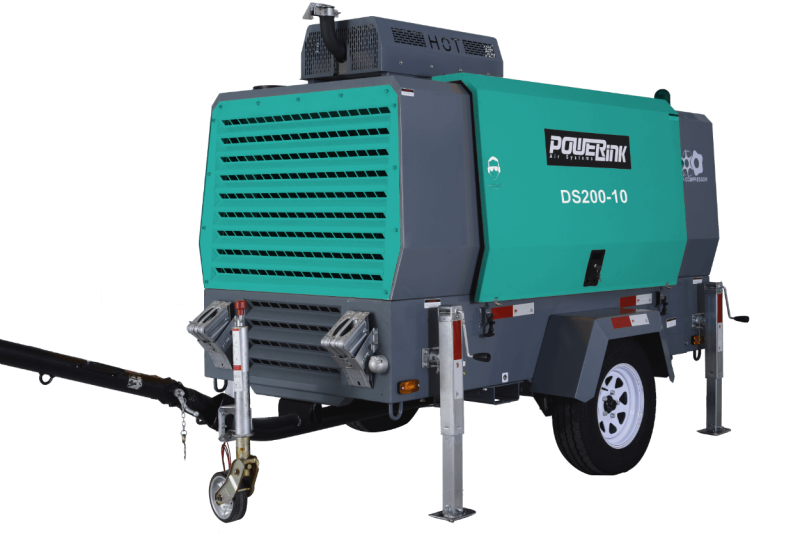
PowerLink air compressors utilize advanced rotary screw technology to deliver dependable performance in construction, mining, drilling, oil and gas, and other heavy-duty environments.
Key Features of PowerLink Rotary Screw Air Compressors:
- Airflow capacities up to 1,400 CFM
- Working pressures up to 24 bar
- Continuous-duty operation for demanding job sites
- High-efficiency screw air ends for reliable performance
- User-friendly intelligent control systems
- Low-noise enclosure designs
- Available in both portable diesel-powered and stationary configurations
These features make rotary screw compressors an excellent choice for projects that require consistent airflow, fuel efficiency, and long-term reliability.
Dynamic Compressors
Unlike positive displacement compressors, dynamic compressors increase air pressure by accelerating airflow and converting velocity into pressure energy.
Centrifugal Compressors
Among dynamic compressors, centrifugal compressors are the most widely used. Instead of trapping and compressing a fixed volume of air, they increase air pressure by accelerating airflow and converting velocity into pressure energy.
A centrifugal compressor uses a high-speed rotating impeller to draw air into the center of the machine and force it outward. As the air passes through a diffuser, its velocity is converted into pressure, producing a continuous flow of compressed air.
Because of their ability to handle large volumes of air efficiently, centrifugal compressors are commonly used in large industrial facilities where high airflow is more important than extremely high pressure.
Common applications include:
- Power generation facilities
- Petrochemical plants
- Steel manufacturing
- Large industrial processing facilities
Benefits of Centrifugal Compressors:
- High airflow capacity
- Continuous, vibration-free operation
- Excellent efficiency in large-scale applications
- Lower maintenance requirements for high-volume air systems
How Does an Air Compressor Work?
An air compressor works by converting power from an electric motor, diesel engine, or gas engine into potential energy stored in compressed air. An air compressor sucks in atmospheric air, compresses it to a higher pressure, and stores it in a tank for later use.
Here’s how an air compressor works:
- An electric motor or engine powers a pump, which draws air from the atmosphere through an intake valve.
- A pump compresses the air and forces it into a storage tank where it is pressurized.
- When the pressure inside the tank reaches a certain level, the pressure switch automatically turns off the compressor to prevent overpressure.
- The compressed air in the tank can be used to power tools and equipment, inflate tires, or perform a variety of other tasks.
- When the air in the tank runs out, the compressor will restart to replenish more compressed air into the tank.